


CFE's Case Studies
Farm Expansion – Containerised heating system & shed heaters (2026)
Sector - Agriculture, poultry
Region - South Lincolnshire
Background - With stocking density reduction on the existing 4 shed broiler facility, an opportunity arose for 2 new additional sheds adjacent to the existing 4 sheds. Existing heating consisted of 1 x Linka straw fired 995 kW boiler backed up with externally mounted direct fired Hired Hand LPG heaters on each shed.
Challenge - Extend existing heating system serving 4 No. broiler sheds to cater for additional 2 new sheds. Mitigate the direct fired Hired Hand LPG heaters to provide dry heat bac up. Provide centralised back up via the wet system and fan coil heater in each shed to maintain consistent dry heat. Maximise straw /biomass as the main source of fuel via load sharing controls. Other factors include fuel security, carbon reduction and RHI income streams / ROI
Solution - New containerised boiler room housing 2 x 800 kW Hoval Ultragas boilers, low loss header and associated mechanical/electrical systems. Heat from the biomass boiler re piped into the new boiler room and distributed via pre insulated underground pipework. Load sharing controls designed to maximise straw using LPG to meet the peak demand and provide full back up. Another consideration for the containerised boiler room was fire separation from the straw boiler room and store. Heat in the new sheds is distributed via Multiheat hot water fan coils.
Main components - Containerised boiler room, 2 x Hoval 800kW Ultragas LPG boilers, pre insulated underground pipework, Multiheat shed internal fan coil heat emitters, load sharing controls and integration.
Scope - Turn key project, coordinating with main building contractors, groundworkers, electricians and controls engineers.
Annual energy usage - 3,000,000 kWh
Estimated energy mix - 80% biomass, 20% LPG


Farm Expansion - New heating system (2026)
Sector - Agriculture, poultry
Region - Lincolnshire
Background - With stocking density reduction on the existing 4 shed broiler facility, an opportunity arose for 2 new additional sheds adjacent to the existing 4 sheds. Existing heating consisted of 1 x Linka straw fired 995 kW boiler backed up with 1 x centralised Potterton LPG 1500 kW boiler
Challenge - Extend existing heating system serving 4 No. broiler sheds to cater for additional 2 new sheds. Provide coil heater in each new shed to maintain consistent dry heat. Maximise straw /biomass as the main source of fuel via load sharing controls. Other factors include fuel security, carbon reduction and RHI income streams / ROI
Solution - Connect the 2 new shed to the existing Low loss header with new pumps, and associated mechanical/electrical systems. Heat from the biomass boiler re piped into the new boiler room and distributed via pre insulated underground pipework. Load sharing controls designed to maximise straw using LPG to meet the peak demand and provide full back up. Heat in the new sheds is distributed via Multiheat hot water fan coils.
Main components - Boiler room pipework, pumps and controls. Pre insulated underground pipework, across to new sheds, Multiheat shed internal fan coil heat emitters, load sharing controls and integration.
Scope - Turn key project, coordinating with main building contractors, groundworkers, electricians and controls engineers.
Annual energy usage - 3,100,000 kWh
Estimated energy mix - 80% biomass, 20% LPG


New Farm – Grade A waste wood heating system & AHUs (2026)
Sector - Agriculture, poultry
Region - Lancashire
Background - Demand from Preston based integrator Gaffour lead an existing independent grower to seek planning application for a new 5 shed broiler facility on a greenfield site, owned land, local to an existing broiler production facility.
Challenge - Meet the new sites energy demands with sustainable, low cost, low carbon technologies whilst delivering a good ROI to satisfy owners and banks. Fuel costs and supply to be as stable as possible.
Solution - Heat: Having reviewed all fuel sources including manure, Identifying good availability of grade A recycled timber formed the foundation of the scheme. A centralised boiler building housing biomass boiler plant , heavy duty walking floor fuel feed and Kerosene back up provides hot water via pre insulated underground pipework to each new shed. High capacity AHU’s within the sheds distribute heat with integrated hot water control valves and variable speed distribution fans.
Electrical consumption for the site is partially met by a 500 kW PV array (by others)
Main components - Justen 1.6 MW biomass boiler system, complete with walking floor& bag filter. 2 x ICI Caldare 800 kW kerosene boilers integrated to provide centralised back up. Boiler room pipework, pumps, associated mechanical / electrical components and controls. Pre insulated underground pipework, across to new sheds. 2 x CFE Air handling units / shed providing space heating / air mixing, controlled via the poultry house climate control computer.
Scope - Turn key heat system project, coordinating with main building contractors, groundworkers, electricians and controls engineers.
Annual energy usage - 4,500,000 kWh
Estimated energy mix - 90% biomass, 10% Kerosene

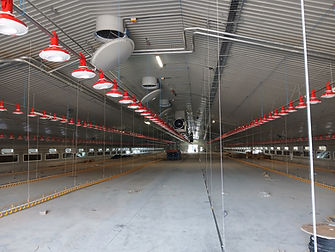


New Farm – Grade A waste wood heating with heat recovery system (2026)
Sector - Agriculture, poultry
Region - North Yorkshire
Background - Demand from integrators lead an existing independent grower to seek planning application for a new 6 shed broiler facility on a greenfield site.
Challenge - Meet the new sites energy demands with sustainable, low cost, low carbon technologies whilst delivering a good ROI to satisfy owners and banks. Fuel costs and supply to be as stable as possible.
Solution -
Heat recovery: High capacity Multiheat heat recovery units are installed using filtered air and large X flow heat exchangers to extract around 50% of the rejected heat usually lost to atmosphere.
Heat: Having reviewed all fuel sources including manure, Identifying good availability of virgin & grade A recycled timber formed the foundation of the scheme. A centralised boiler building housing biomass boiler plant, automated fuel feed and Kerosene back up provides hot water via pre-insulated underground pipework to each new shed. Multiheat fan coil heaters within the sheds distribute heat with integrated controls. Electrical consumption for the site is partially met by a 300 kW PV array (by others).
Main components -
6 x Multiheat heat exchanger systems (1/shed) with 6 x internal air circulation fans/shed to evenly distribute air around the growing area.
1 x Heizomat 1 MW biomass boiler system, complete with automated fuel feed and electrostatic filtration. 1 x ICI Caldare 1600 kW kerosene boilers integrated to provide centralised back up. Boiler room pipework, pumps, associated mechanical /electrical components and controls. Pre insulated underground pipework, across to new sheds. 4 x Multiheat fan coil units / shed providing space heating /air mixing, controlled via the poultry house climate control computer.
Scope - Turn key heat system project, coordinating with main building contractors, groundworkers, electricians and controls engineers.
Annual energy usage - 3,000,000 kWh
Estimated energy mix - 90% biomass, 10% Kerosene


Farm Expansion – Heat recovery system and shed heaters (2025)
Sector - Agriculture, poultry
Region - Nottinghamshire
Background - Demand from integrators lead an existing independent grower to seek planning permission for an additional 2 new sheds on the exiting 8 shed unit.
Challenge - Meet the new sheds energy demands with sustainable, low cost, low carbon technologies whist having minimum impact on the existing site 8 sheds general management and operation. The existing 8 sheds are served by 2 x Hoval wood pellet systems with no capacity for more heat demand. As these systems run efficiently with around 10 yrs remaining term on the RHI, the additional 2 new sheds should be independently heated.
Solution - Minimise heat usage.
Heat recovery: High capacity Multiheat heat recovery units are installed using filtered air and large X flow heat exchangers to extract around 50% of the rejected heat usually lost to atmosphere.
Heat: Having reviewed all fuel sources available, the decision to install indirect fired LPG heaters to run along side the heat recovery would suit the site staff & management for the next 10 yrs. A centralised low cost biomass plant is to be considered post RHI to serve all 10 sheds. Fuel availability and geography at this point points to centralised straw plant
at that time
Main components - 2 x Multiheat heat exchanger systems (1/shed) with 6 x internal air circulation fans/shed to evenly distribute air around the growing area.
Scope - Turn key heat recovery system project, coordinating with main building contractors, groundworkers, electricians and controls engineers.
Annual energy savings for 2 new sheds - 450,000 kwh/yr
Based on existing sheds annual energy usage and 50% heat recovery
Annual LPG fuel cost savings based on LPG @45p/litre - £31,500


Multi-site Biomass Straw Heating System (2024)
Sector - Agriculture, poultry
Region -Lincs
Challenge – Reduce LPG costs and carbon emissions for a large scale poultry producer across 4 No. separate farm sites. Reduce reliance on unstable fossil fuels
Solution – 4 No. Automated straw heating system & district heating networks serving 24 No. buildings total, utilising home produced straw fuel
Main components – 4 No. 1.6MW Justsen boilers/Reka straw feed & chopper systems , pre insulated underground pipework, shed internal fan coil heat emitters.
Scope – Turn key project, coordinating with main building contractors, electricians and controls engineers.
Annual energy usage – 8,400,000 kWh
Annual Carbon saving – 1.824 T/yr

Heat Recovery - Green herb drier (2019)

Sector – Food processing
Region – Suffolk
Challenge – Increase efficiency, reduce fuel cost and carbon from an existing green leaf LPG fired herb drying facility.
Solution – Design & install an efficient heat recovery system around the existing LPG belt drier system
Fuel type – Reduce LPG usage
Main components – Hoval cross flow air to air heat exchange matrix, housed in bespoke cabinets. Ducting & exhaust system, filtration & controls
Scope – Turn key project
Annual energy Savings – 93,750 Litres LPG
Annual Carbon saving - 21,562 Tonnes
AD plant - utilising rejected heat (2019)
Sector – Energy/power production
Region - Norfolk
Challenge – Utilise 500 kW of rejected heat from an existing AD plant to serve a proposed Heston straw bale drier rejected from a local straw fired power station
Solution – Divert rejected heat to a new underground heating mains serving a straw bale drier system.
Fuel type – Rejected waste heat from existing AD plant
Heat use – Straw drying plant serving local power station
Main components – mechanical pipework, heat exchangers, electrical & controls
Annual rejected heat mitigation – 3,200,000 kwh/yr

Utilise rejected heat from existing AD plant (2018)

Sector – Food production / Agriculture
Region – S Lincs
Challenge – Utilise 500 kW of rejected heat from an existing AD plant to heat poultry facility approx. 350m away.
Solution – Divert rejected heat from AD plant engine room to a new underground heating mains terminating in a containerised heat station adjacent to the poultry facility. Distribute heat into the individual poultry houses via pumped circuits & = wall mounted finned pipe heat emitters.
Fuel type – Rejected waste heat from existing AD plant
Heat use – Modern poultry farm
Main components – Mechanical pipework, heat exchangers, electrical & controls
Annual rejected heat mitigation – 2,800,000 kwh/yr


Waste wood heating system (2017)
Sector - Horticulture
Region - Lincs
Challenge – Design & install a boiler system to utilise stable priced grade A&B waste wood within the existing space envelope, to minimise fossil fuel usage
Solution – Remove existing plant, alter building, install new 3MW waste wood boiler system and ancillaries.
Fuel type – Recycled waste wood
Main components – Justsen 3MW boiler
Scope – Turn key project
Annual energy usage – 18,000,000 kWh
Annual Carbon saving - 3,588,480 kg

Biomass straw heating system (2017)
Sector - Agriculture, poultry
Region - Yorks
Challenge - Utilise a local sustainable, low carbon fuel source to manage fuel costs.
Solution - Automated straw heating system, fuel sourced within 4 mile radius.
Fuel type – Heston bale Straw & Miscanthus
Main components – Justsen/Reka 1MW
Scope – Turn key project
Annual energy usage – 2,100,000 kWh
Annual Carbon saving – 418,656 kg
Wood pellet heating system (2016)
Sector - Agriculture, poultry
Region - Lincs
Challenge - New build site – Design an easy to manage low carbon heating system
Solution – Packaged plant room boiler system, district heating system serving multiple buildings, internal M&E including fan coil heat emitters & controls
Fuel type – Wood pellet
Main components – Hoval 975 kW boiler
Scope – Turn key project
Annual energy usage – 2,400,000 kWh
Annual Carbon saving – 478,464 kg


Virgin wood chip heating system (2016)


Sector - Agriculture
Region - Wiltshire
Challenge – Explore low carbon heating options for a new build site
Solution – Based on the good local availability of price stable virgin wood chip, design & install a wood chip heating system with pre insulated underground heating mains, internal fan coil heat emitters and integrated controls
Fuel type – Virgin wood chip
Main components – Herz Biofire 1MW boiler, ICI Caldare LPG 1MW
Scope – Turn key project
Annual energy usage – 1,500,000 kWh
Annual Carbon saving - 299,040 kg
Sector - Agriculture
Region - Cambs
Challenge – Displace existing fossil fuel heating with low carbon and more stable priced fuel
Solution – Packaged plant room boiler system, district heating system serving multiple buildings, internal M&E including fan coil heat emitters & controls
Fuel type – Pellet
Main components – Packaged 1MW plant room -pellet boiler
Scope – Turn key project
Annual energy usage – 1,600,000 kWh
Annual Carbon saving - 318,976 kg
Packaged plant room (13x4m) Heating (2016)


Manure heating system (2015)
Sector - Agriculture
Region - Shropshire
Challenge – Utilise low value poultry manure as an energy source to meet stringent legislation surrounding manure combustion
Solution – Stand alone new building housing the manure store, automated Top Loader fuel feed and fluidised bed boiler system serving 6 No poultry houses. Underground pre insulated heating mains and internal poultry house fan coils systems, integrated controls
Fuel type – Poultry manure
Main components – FBC 750 kW boiler & automated Top Loader fuel feed system
Scope – Turn key project
Annual energy usage – 4,500,000 kWh
Annual Carbon saving - 897,120 kg
